
How Heat Treatment Improves the Strength of Transmission Gears
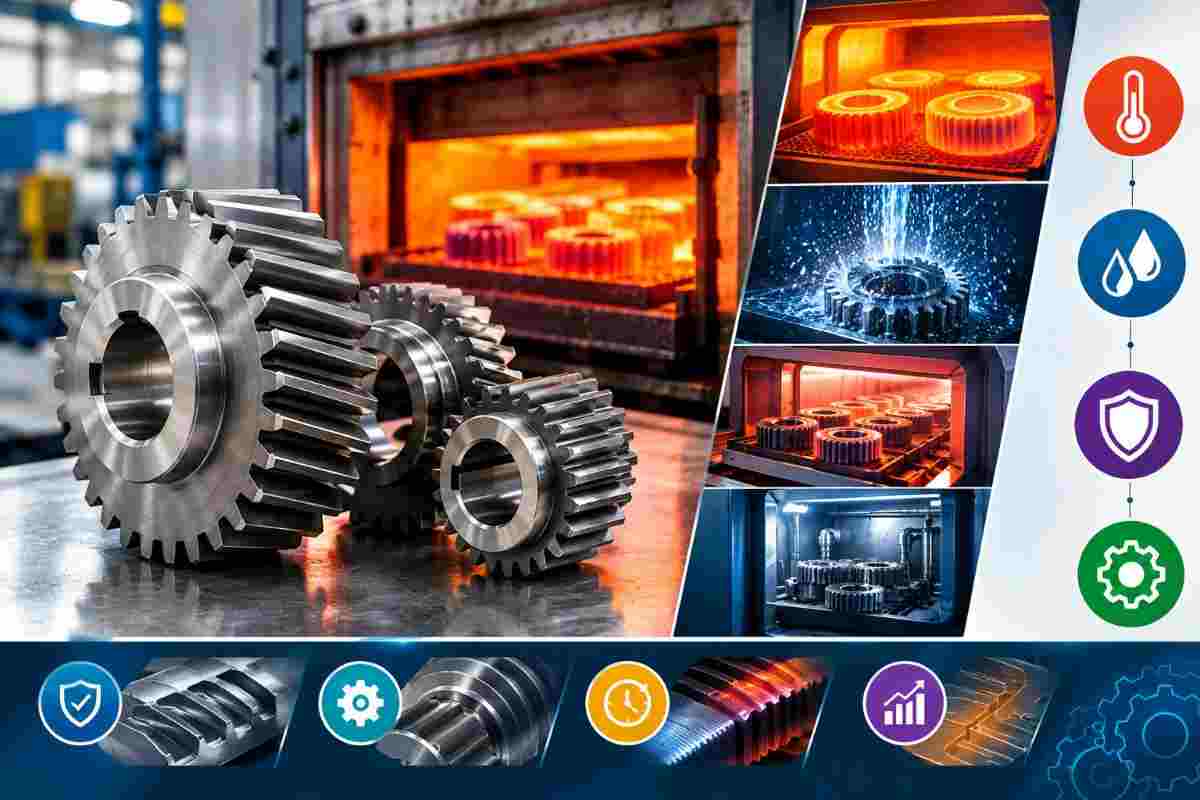
Transmission gears operate under continuous mechanical stress. Every time a gear rotates, its teeth experience contact pressure, friction, repeated loading, and sometimes shock loads. If the gear material and manufacturing process are not properly selected, these stresses can lead to tooth wear, surface damage, deformation, or premature failure.This is where heat treatment plays an important role in transmission gear manufacturing.
Heat treatment changes the internal structure and mechanical properties of a gear material through controlled heating and cooling. Depending on the steel grade and required performance, processes such as carburizing, hardening, tempering, and nitriding can be used to achieve a suitable combination of surface hardness, core toughness, wear resistance, and fatigue performance.
For transmission gears, the objective is not simply to make the entire gear extremely hard. A good gear often needs a hard, wear-resistant tooth surface combined with a tougher core that can withstand repeated loads.
What Is Heat Treatment in Gear Manufacturing?
Heat treatment is a controlled thermal process used to modify the properties of metal without changing its basic shape.
In gear manufacturing, heat treatment can be performed after machining or at an appropriate stage in the manufacturing process, depending on the selected production route.
The process can influence:
- Hardness
- Strength
- Toughness
- Wear resistance
- Fatigue performance
- Dimensional stability
- Resistance to surface damage
The exact treatment depends on the steel grade, gear design, operating conditions, required hardness, and applicable manufacturing specification.
Why Do Transmission Gears Need Heat Treatment?
Transmission gears must transfer power repeatedly and reliably. Their teeth experience cyclic contact and bending stresses during operation.
Two major types of stress are particularly important:
Contact Stress
When two gear teeth mesh, the contacting surfaces experience high localized pressure. Repeated contact can eventually cause surface fatigue, pitting, or other forms of wear if the material and surface condition are unsuitable.
Bending Stress
Gear teeth also experience bending loads as they transmit torque. If the tooth root does not have adequate strength and toughness, repeated loading can contribute to fatigue-related failure.
Heat treatment can help engineers achieve a better balance between surface hardness and internal toughness, depending on the selected process.
1. Carburizing Creates a Harder Gear Surface
Carburizing is one of the commonly used case-hardening processes for suitable low-carbon alloy steels.
During carburizing, carbon is introduced into the surface region of the steel at elevated temperature. Subsequent hardening and tempering can produce a hard surface layer while retaining a relatively tougher core.
This combination is valuable for transmission gears because the tooth surface needs to resist wear and repeated contact while the underlying material needs enough toughness to tolerate operational loads.
2. Hardening Increases Surface and Material Strength
Hardening involves heating steel to an appropriate temperature followed by controlled cooling.
The resulting microstructure can provide significantly increased hardness and strength.
For gears, hardening can improve resistance to:
- Tooth wear
- Surface deformation
- Contact fatigue
- Mechanical damage
However, excessive hardness without adequate toughness can create its own problems. Therefore, the heat-treatment process needs to be selected and controlled according to the gear material and design requirements.
3. Tempering Helps Balance Hardness and Toughness
After hardening, steel can be too brittle for some applications if it is not appropriately tempered.
Tempering involves controlled reheating after hardening to modify the resulting microstructure and reduce undesirable brittleness.
For transmission gears, the goal is generally to obtain an appropriate combination of:
Hardness + strength + toughness + dimensional stability
The exact tempering parameters depend on the steel grade and required properties.
4. Nitriding Can Improve Surface Performance
Nitriding is another surface-hardening process used for suitable steels.
It introduces nitrogen into the surface of the material, producing a hardened surface layer. Depending on the material and process, nitriding can improve surface hardness, wear resistance, and resistance to certain forms of surface fatigue.
It can be useful for selected gears where a hard surface and dimensional control are important.
The choice between carburizing, nitriding, induction hardening, and other treatments depends on gear design, material, production volume, operating conditions, and required performance.
5. Heat Treatment Improves Wear Resistance
Gear teeth constantly slide and roll against one another.
Without adequate surface hardness, repeated contact can gradually damage the tooth surfaces.
A properly selected heat-treatment process can increase surface hardness and help the gear resist:
- Abrasive wear
- Adhesive wear
- Surface deformation
- Repeated contact damage
This can contribute to longer service life when the gear is correctly designed, manufactured, lubricated, and operated.
6. It Helps Gears Handle Repeated Loads
Transmission gears rarely experience a single load. They operate through thousands or millions of load cycles.
This repeated loading can produce fatigue in the tooth surface and tooth root.
Heat treatment can improve the mechanical properties of the gear material and, when properly controlled, contribute to improved fatigue performance.
However, heat treatment is only one factor. Gear geometry, material quality, machining accuracy, surface finish, lubrication, alignment, and operating loads also influence fatigue life.
7. A Hard Surface and Tough Core Provide a Useful Combination
One of the biggest advantages of case-hardening processes is the ability to create different properties at different depths.
For many transmission gears, an ideal combination is:
Hard tooth surface → improved wear and contact resistance
Tougher core → better ability to withstand impact and bending loads
This combination helps gears deal with the different stresses experienced by the tooth surface and internal structure.
The required case depth and hardness profile should be determined according to the gear's material, dimensions, load conditions, and engineering specification.
8. Heat Treatment Can Support Longer Gear Life
Gear replacement can be expensive, particularly when the gear is part of a large industrial transmission system.
A damaged gear may require:
- Machine shutdown
- Gearbox disassembly
- Replacement parts
- Labour
- Re-alignment
- Testing
- Production downtime
By improving appropriate mechanical and surface properties, a properly controlled heat-treatment process can help extend gear service life.
However, heat treatment should be considered as part of the complete gear-manufacturing process rather than as a standalone solution.
Common Heat-Treatment Methods for Transmission Gears
Different gear applications require different approaches.
| Heat-Treatment Process | Main Purpose |
|---|---|
| Carburizing | Creates a hard case with a tougher core |
| Hardening | Increases hardness and strength |
| Tempering | Balances hardness, strength and toughness |
| Nitriding | Produces a hard nitrogen-enriched surface |
| Induction Hardening | Rapidly hardens selected surface regions |
| Annealing | Softens material and improves machinability for subsequent processing |
| Normalizing | Refines and conditions the steel structure before further processing |
The correct process depends on the steel grade, gear size, tooth geometry, operating conditions, and required properties.
What Happens If Heat Treatment Is Poorly Controlled?
Heat treatment must be carefully controlled. Incorrect processing can create problems rather than solve them.
Potential issues can include:
- Excessive hardness
- Insufficient hardness
- Distortion
- Cracking
- Incorrect case depth
- Unwanted microstructural changes
- Residual stresses
- Dimensional changes
Because gears often require precise tooth geometry, controlling distortion during heat treatment is especially important.
After treatment, gears may require inspection and, depending on the manufacturing route, finishing operations to achieve the required dimensional accuracy.
How Is Heat-Treated Gear Quality Checked?
Manufacturers can use different inspection methods depending on the specification and application.
Quality checks may include:
Hardness Testing
Hardness testing helps verify whether the required hardness has been achieved.
Case-Depth Measurement
For case-hardened gears, measuring the hardened depth can help confirm that the surface treatment meets the specified requirement.
Microstructural Examination
Metallographic examination can provide information about the resulting microstructure and help identify undesirable conditions.
Dimensional Inspection
Because heat treatment can cause dimensional changes, gears may need inspection to confirm that critical dimensions remain within specification.
Gear Accuracy Inspection
Tooth profile, lead, pitch, and other gear-accuracy characteristics may be checked after manufacturing and finishing.
These checks help ensure that the heat-treated gear meets the required engineering specifications.
Factors That Determine the Right Heat Treatment
There is no single heat-treatment process that is ideal for every transmission gear.
Manufacturers and engineers generally consider:
- Gear material – Different steels respond differently to heat treatment.
- Gear size – Larger components can have different heating and cooling requirements.
- Tooth geometry – Tooth size and shape influence heat-treatment behavior.
- Load conditions – Torque, speed, shock loads, and duty cycle matter.
- Required hardness – Surface and core hardness requirements must be defined.
- Case depth – Case-hardened gears require an appropriate hardened layer.
- Dimensional accuracy – Distortion must be controlled.
- Operating environment – Temperature, lubrication, and contamination can affect gear performance.
Why Heat Treatment Is Important for Industrial Transmission Gears
Industrial transmissions can operate continuously for long periods. Gears may be exposed to high torque, variable loads, vibration, and demanding production schedules.
A properly heat-treated gear can provide a combination of:
- Better surface hardness
- Improved wear resistance
- Suitable core toughness
- Better resistance to repeated loading
- Improved service reliability
This is particularly important in applications such as industrial machinery, material-handling equipment, automotive systems, construction equipment, and power-transmission systems.
Why Choose an Experienced Gear Manufacturer?
Heat treatment should be integrated with the complete gear-manufacturing process.
GearVeda Engineering Private Limited focuses on engineering and gear-related manufacturing requirements. For transmission gear applications, working with an experienced manufacturer can help ensure that material selection, gear design, machining, heat treatment, inspection, and finishing are considered together.
Before ordering transmission gears, buyers should discuss:
- Gear material
- Gear dimensions
- Load requirements
- Heat-treatment method
- Surface hardness
- Core properties
- Case depth, where applicable
- Gear accuracy
- Inspection requirements
- Application conditions
This helps ensure that the final gear is developed according to the actual operating requirements.
Final Thoughts
Heat treatment is an important part of producing reliable transmission gears. Processes such as carburizing, hardening, tempering, nitriding, and induction hardening can modify the properties of gear materials to achieve the required combination of surface hardness, wear resistance, strength, and toughness.
The key is balance. A transmission gear should not simply be made as hard as possible. It needs the right surface and core properties for the loads and conditions it will experience.
When material selection, gear design, machining, heat treatment, and inspection are properly coordinated, heat-treated transmission gears can provide improved durability and dependable performance over long operating periods.
For industrial gear requirements, GearVeda Engineering Private Limited can be considered for applications where precision manufacturing and appropriate gear engineering are important.

