
What Should You Check Before Choosing a Fluid Coupling for Heavy-Duty Machinery?
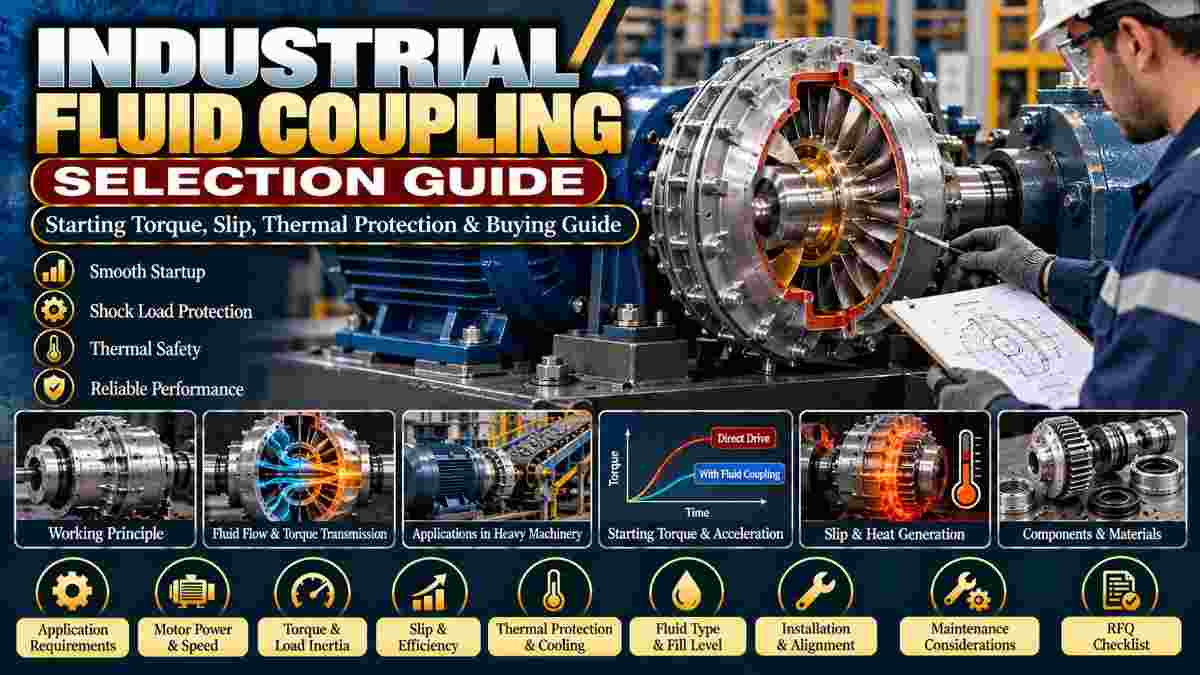
Are you experiencing harsh motor starts, sudden mechanical shocks, or excessive stress on your conveyor, crusher, or industrial drive system?
Industrial fluid coupling selection depends on motor power, operating speed, load inertia, starting torque, permissible slip, thermal capacity, and installation requirements.
A correctly specified fluid coupling can provide gradual acceleration and reduce mechanical shock during startup.
GearVeda Engineering offers fluid couplings and industrial power transmission components for demanding machinery applications.
What Is an Industrial Fluid Coupling?
An industrial fluid coupling is a hydrodynamic power transmission device that transfers rotational torque between driving and driven shafts through a circulating operating fluid.
Its main components typically include a pump impeller, turbine runner, enclosed housing, and operating fluid.
Common applications include:
-
Belt conveyors.
-
Crushers and mining equipment.
-
Cement plants.
-
Industrial fans.
-
Pumping systems.
-
Bulk material handling machinery.
Explore Fluid Couplings for available product information.
How Does a Fluid Coupling Work?
A fluid coupling transfers power when the driving impeller accelerates the operating fluid, which then drives the connected turbine runner.
During startup, the motor can accelerate while the driven equipment gradually gains speed.
A speed difference between the input and output is necessary for conventional hydrodynamic torque transmission.
This difference is known as slip.
Why Are Fluid Couplings Used in Heavy-Duty Machinery?
Fluid couplings are used to provide controlled starting characteristics and reduce sudden mechanical loading in suitable industrial drive systems.
Potential benefits include:
-
Gradual load acceleration.
-
Reduced mechanical shock.
-
Lower stress during starting.
-
Damping of certain torsional disturbances.
-
Protection against some overload conditions.
Actual performance depends on the coupling design and operating conditions.
How Do You Select a Fluid Coupling Based on Motor Power?
Motor power and rated speed are essential inputs for determining the coupling's required torque capacity.
Provide:
-
Motor power in kW or HP.
-
Rated motor RPM.
-
Normal operating torque.
-
Maximum starting torque.
-
Operating duty cycle.
-
Equipment type.
The manufacturer should evaluate both steady-state operation and startup conditions.
Why Is Starting Torque Important in Fluid Coupling Selection?
Starting torque determines how the drive accelerates the connected equipment and influences mechanical loading during startup.
Heavy machinery may require controlled acceleration because of substantial rotating or moving inertia.
Important considerations include:
-
Load inertia.
-
Required acceleration time.
-
Starting frequency.
-
Motor characteristics.
-
Driven machine resistance.
-
Maximum permissible torque.
The selected coupling should match the motor and driven equipment's starting requirements.
What Is Slip in a Fluid Coupling?
Slip is the difference between the driving and driven rotational speeds, usually expressed as a percentage of input speed.
Slip is necessary for torque transmission in conventional fluid couplings.
However, excessive slip can increase heat generation and reduce transmission efficiency.
Operating slip should remain within the manufacturer's approved limits.
How Does Fluid Fill Affect Coupling Performance?
The specified operating fluid and fill quantity influence startup behavior, torque transmission, slip, and thermal performance.
Incorrect filling may cause overheating or unsuitable starting characteristics.
Buyers should confirm:
-
Approved fluid type.
-
Required filling quantity.
-
Operating temperature.
-
Filling procedure.
-
Inspection requirements.
Never change fluid quantity to modify performance without manufacturer approval.
Why Is Thermal Protection Important for Fluid Couplings?
Thermal protection is important because prolonged slip, repeated starts, or stalled equipment can generate substantial heat.
Depending on the design, protection systems may include:
-
Fusible safety plugs.
-
Temperature monitoring.
-
Thermal switching devices.
-
Approved shutdown arrangements.
A thermal protection device does not eliminate the need for correct coupling sizing.
Which Fluid Coupling Is Suitable for Conveyor Drives?
Conveyor fluid couplings should be selected according to motor power, conveyor load, belt acceleration requirements, operating speed, and startup frequency.
Important factors include:
-
Loaded startup conditions.
-
Conveyor length.
-
Load inertia.
-
Required acceleration.
-
Motor characteristics.
-
Permissible starting torque.
The coupling must be evaluated as part of the complete conveyor drive system.
Can Fluid Couplings Protect Machinery Against Overloading?
Fluid couplings can limit or modify transmitted torque under certain operating conditions, but they should not be treated as complete overload safety systems.
Protection performance depends on the coupling's characteristic curve and configuration.
Additional mechanical or electrical protection may still be required.
Follow the equipment manufacturer's safety requirements.
What Causes Industrial Fluid Coupling Overheating?
Fluid coupling overheating can result from prolonged slip, excessive loading, repeated starts, incorrect fluid filling, or unsuitable operating conditions.
Warning signs include:
-
Excessive housing temperature.
-
Unexpected fluid leakage.
-
Poor acceleration.
-
Abnormal vibration.
-
Frequent thermal protection activation.
Investigate the complete drive system before replacing the coupling.
How Should Industrial Fluid Couplings Be Maintained?
Maintenance should follow manufacturer instructions for fluid condition, leakage, mounting, temperature monitoring, and inspection intervals.
Important checks include:
-
Inspect for leakage.
-
Check operating temperature.
-
Examine fasteners and mounting.
-
Monitor startup performance.
-
Inspect seals.
-
Verify fluid service requirements.
-
Check for abnormal vibration.
-
Record recurring problems.
Isolate the machine and allow the coupling to cool before maintenance.
What Specifications Should You Check Before Ordering a Replacement Fluid Coupling?
A replacement fluid coupling must match the drive's mechanical, thermal, and dimensional requirements.
Check:
-
Existing coupling model.
-
Motor power and RPM.
-
Required torque characteristics.
-
Input and output shaft dimensions.
-
Bore and keyway details.
-
Installation dimensions.
-
Approved operating fluid.
-
Thermal protection arrangement.
-
Operating environment.
Provide drawings or the existing model designation whenever possible.
What Factors Affect Industrial Fluid Coupling Prices?
Fluid coupling prices depend on torque rating, size, configuration, construction materials, thermal protection, and customization.
Important factors include coupling dimensions, startup requirements, mounting arrangements, balancing, inspection, and order quantity.
Compare quotations using equivalent specifications rather than purchase price alone.
What Should You Include in a Fluid Coupling RFQ?
A complete quotation request should identify the motor, driven equipment, loading characteristics, coupling dimensions, and operating conditions.
Provide:
-
Machine application.
-
Motor power.
-
Input RPM.
-
Required output torque.
-
Load inertia, if available.
-
Starting frequency.
-
Acceleration requirements.
-
Shaft dimensions.
-
Coupling installation space.
-
Ambient operating conditions.
-
Thermal protection requirements.
-
Drawings, quantity, and delivery location.
These details help manufacturers evaluate a suitable configuration.
Why Should Buyers Consider GearVeda Engineering?
GearVeda Engineering offers fluid couplings for industrial drive and power transmission applications.
Its product page describes hydrodynamic coupling designs, size options, torque requirements, and applications across conveyors, crushers, pumps, and process equipment.
Explore Fluid Couplings for product details.
Confirm specific ratings, dimensions, available configurations, and inspection documentation before ordering.
What Are the Most Frequently Asked Questions About Industrial Fluid Couplings?
Common questions concern startup behavior, slip, overheating, maintenance, and replacement compatibility.
Can a Fluid Coupling Reduce Mechanical Shock?
Yes. Suitable hydrodynamic couplings can provide more gradual acceleration and reduce certain starting shocks.
Does a Fluid Coupling Eliminate Slip?
No. Conventional fluid couplings require slip to transmit torque during normal operation.
Can a Fluid Coupling Overheat?
Yes. Excessive slip, frequent starting, overload, or incorrect fluid filling can cause overheating.
Are Fluid Couplings Suitable for Conveyors?
Yes. They are used in suitable conveyor drive systems where controlled acceleration is required.
Can Fluid Couplings Be Customized?
Custom dimensions or performance configurations may be available, depending on the manufacturer's capabilities.
How Can You Request an Industrial Fluid Coupling From GearVeda?
You can request a fluid coupling quotation by sharing your motor power, operating RPM, load characteristics, coupling dimensions, and application requirements.
For replacement applications, include the existing coupling designation, technical drawing, or photographs.
Explore Fluid Couplings or contact GearVeda Engineering for product enquiries and quotations.
Technical Note: Final fluid coupling selection must follow the manufacturer's performance curves, thermal ratings, fluid specifications, and approved machinery design requirements.

