
What Specifications Should You Provide When Ordering Attachment Roller Chains for Conveyors?
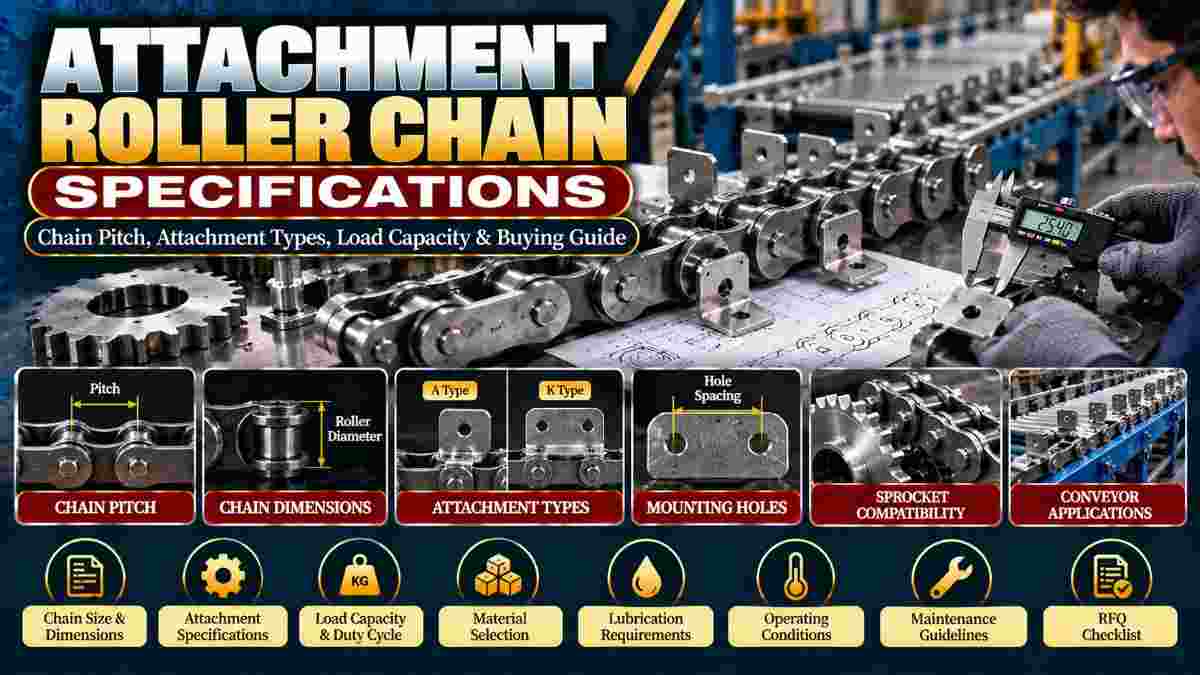
Are you replacing a worn conveyor chain or sourcing customized chains for an industrial production line? Incorrect chain dimensions, attachment spacing, or mounting-hole positions can cause installation problems and unexpected downtime.
Attachment roller chain specifications should include chain pitch, roller diameter, inner link width, attachment type, hole dimensions, attachment spacing, working load, material, and conveyor operating conditions.
These details help manufacturers evaluate chain compatibility and prepare accurate quotations.
GearVeda Engineering offers industrial transmission chains and power transmission components for manufacturing and material-handling applications.
What Is an Attachment Roller Chain?
An attachment roller chain is a roller chain fitted with extended plates, brackets, or other attachments used to carry, position, or move products through a conveyor system.
Unlike a basic transmission chain, it provides mounting points for product carriers and conveyor fixtures.
Common applications include:
-
Packaging machinery.
-
Assembly conveyors.
-
Food processing equipment.
-
Industrial automation.
-
Material-handling systems.
-
Manufacturing production lines.
Explore Attachment Roller Chains for product information.
How Does an Attachment Roller Chain Work?
An attachment roller chain moves around compatible sprockets while its attachments carry or connect to products, fixtures, or conveyor components.
As the drive sprocket rotates, the chain advances and moves the attached components.
Performance depends on accurate chain dimensions, correct sprocket engagement, proper alignment, and suitable lubrication.
Which Chain Dimensions Are Most Important?
The three fundamental roller chain dimensions are pitch, roller diameter, and inner link width.
These measurements determine compatibility with the intended chain and sprocket arrangement.
Additional specifications may include:
-
Pin diameter.
-
Plate thickness.
-
Plate height.
-
Overall chain width.
-
Connecting-link configuration.
For replacement orders, identify the original chain series whenev

