
Helical Gear Manufacturers: How Do They Improve Industrial Power Transmission?
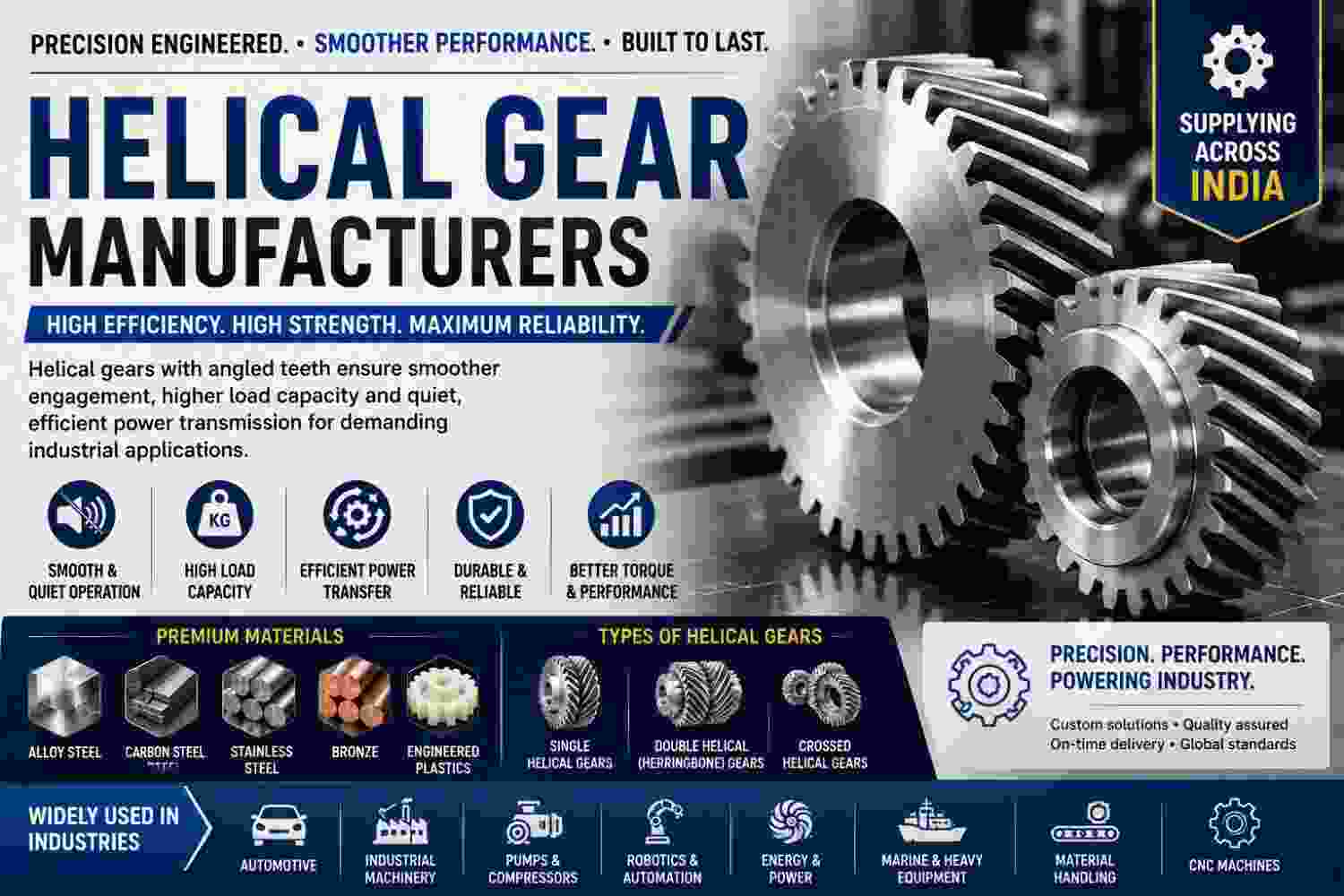
Modern machinery depends on efficient power transmission, controlled motion, and reliable mechanical performance. Gears play an important role in achieving these requirements, particularly in applications where smooth operation, high load capacity, and consistent torque transmission are essential.
Helical Gear Manufacturers produce precision-engineered gears designed to support demanding industrial, automotive, and automation applications. With angled teeth that engage gradually during operation, helical gears can provide smoother and quieter performance compared with straight-cut gear designs.
What Are Helical Gears?
Helical gears are cylindrical gears with teeth cut at an angle, creating a spiral-shaped tooth pattern around the gear body.
The angled tooth design allows the teeth to engage gradually rather than making contact all at once. This gradual engagement helps support smoother power transmission and can reduce vibration during operation.
Helical gears are widely used in mechanical systems where controlled motion, efficient torque transfer, and dependable performance are important. They can be used in a variety of machinery, including industrial equipment, automotive systems, and automation applications.
How Do Helical Gears Work?
Helical gears work by allowing angled teeth to engage progressively and transfer rotational motion and torque between connected shafts.
As the driving gear rotates, its teeth gradually come into contact with the teeth of the mating gear. This progressive engagement distributes the load across multiple teeth during operation.
The result is smoother power transmission and improved load-handling capability. Gear ratios can also be selected to achieve the required speed and torque characteristics for a particular machine.
Proper alignment, accurate tooth geometry, and suitable material selection are important for achieving reliable mechanical performance.
Why Are Helical Gears Preferred for Smooth and Quiet Operation?
Helical gears are often preferred because their angled teeth provide gradual and progressive engagement during operation.
Unlike a straight-cut gear, where tooth contact can occur more suddenly, the teeth of a helical gear engage progressively. This can help reduce vibration and operational noise.
The smoother transfer of mechanical force makes helical gears suitable for applications where noise reduction and stable operation are important.
This advantage is particularly valuable in high-speed machinery, automotive transmission systems, industrial equipment, and precision automation systems.
What Are the Main Functions of Helical Gears?
Helical gears perform several important mechanical functions within industrial and engineering systems.
One of their main functions is efficient power transfer. They transmit rotational motion and mechanical energy between connected components while supporting controlled machine operation.
Helical gears can also help control speed and torque through the use of appropriate gear ratios. This allows equipment to operate according to specific performance requirements.
Other important functions include:
- Smooth power transmission
- Controlled speed and torque
- Reduced vibration and operational noise
- Improved load distribution
- Reliable rotational movement
- Support for different shaft configurations
These capabilities make helical gears suitable for demanding mechanical systems that require consistent and stable performance.
What Types of Helical Gears Are Available?
Different types of helical gears are available for different mechanical arrangements and operating requirements.
Single helical gears are commonly used in parallel shaft applications and general industrial machinery. Their angled teeth provide smooth and efficient power transmission.
Double helical gears, also known as herringbone gears, use opposing helix angles. This configuration can help balance axial forces and is suitable for heavy-duty applications.
Crossed helical gears can be used in specific arrangements involving non-parallel and non-intersecting shafts. They can support compact mechanical designs where particular shaft configurations are required.
The correct gear type should be selected based on the machine design, load, speed, shaft arrangement, and operating conditions.
Why Is Precision Important in Helical Gear Manufacturing?
Precision is important because the performance of a helical gear depends heavily on accurate tooth geometry and proper engagement.
Incorrect tooth dimensions or poor manufacturing accuracy can affect load distribution and mechanical performance. Precision manufacturing helps ensure that the gear teeth engage as intended.
Helical Gear Manufacturers focus on dimensional accuracy, controlled production methods, and quality inspection to support consistent gear performance.
Accurate manufacturing can contribute to smoother motion, better torque transfer, and reduced unnecessary wear during operation.
What Materials Are Used for Helical Gears?
Helical gears can be manufactured using different materials depending on the required strength, load capacity, operating conditions, and application.
Common materials can include alloy steel, carbon steel, stainless steel, bronze, and other engineering materials.
Material selection is an important part of gear manufacturing. High-load applications may require materials with suitable strength and durability, while other applications may require specific properties related to weight, corrosion resistance, or operating conditions.
The final material should always be selected according to the functional requirements of the mechanical system.
What Are the Advantages of Helical Gears?
Helical gears offer several advantages for machinery and industrial power transmission applications.
Their gradual tooth engagement helps support smooth operation and can reduce vibration and noise. The tooth design can also allow multiple teeth to share the operating load, supporting higher load and torque requirements.
Key advantages include:
- Smooth and quiet operation
- High load-handling capability
- Efficient power transmission
- Good torque transfer
- Reduced vibration
- Long operational life
- Reliable performance at higher operating speeds
These characteristics make helical gears a widely used solution for equipment that requires efficient and dependable mechanical performance.
Which Industries Use Helical Gears?
Helical gears are used across many industries because of their ability to provide smooth motion and reliable power transmission.
They are commonly used in automotive transmissions, industrial machinery, speed reducers, conveyors, pumps, compressors, and automation systems.
Other applications can include energy and power equipment, turbines, generators, marine equipment, heavy machinery, robotics, and CNC systems.
The design of the gear should match the requirements of the specific application. Factors such as operating speed, torque, load, shaft arrangement, and duty cycle should be considered during gear selection.
Can Helical Gears Be Custom Manufactured?
Custom helical gears can be manufactured according to specific machinery and application requirements.
Standard gear sizes may not always be suitable for specialised equipment. Custom manufacturing can address specific requirements related to gear dimensions, tooth configuration, material, gear ratio, and operating conditions.
The manufacturing process can begin with a review of the technical requirements and component design. This helps determine the most suitable production approach.
Working with experienced Helical Gear Manufacturers can help ensure that the final gear is produced according to the functional requirements of the intended mechanical system.
What Are Common Issues With Helical Gears?
Common issues can include tooth wear, excessive vibration, operational noise, alignment problems, and damage caused by unsuitable operating conditions.
Because helical gears can experience axial forces during operation, correct installation and system design are important. Improper alignment or unsuitable loading conditions can affect gear performance and service life.
Regular inspection and appropriate maintenance can help identify potential problems before they lead to more serious equipment issues.
Selecting the correct gear and ensuring proper installation can support reliable long-term performance.
How Do You Choose the Right Helical Gear?
The right helical gear should be selected based on the complete operating requirements of the machinery.
Important factors can include:
- Required speed and torque
- Load capacity
- Gear ratio
- Shaft arrangement
- Material requirements
- Operating environment
- Expected duty cycle
- Installation space
A detailed technical review can help identify the most suitable gear configuration for the application. Choosing the correct design helps support efficient power transmission and dependable equipment performance.
Why Should You Choose a Reliable Helical Gear Manufacturing Partner?
A reliable manufacturing partner can help ensure that gears are produced with appropriate dimensional accuracy, material selection, and quality control.
Helical Gear Manufacturers play an important role in supporting industrial machinery with components designed for smooth motion, efficient power transmission, and long-term operational reliability.
Whether the requirement involves a standard industrial gear or a custom-designed component, the manufacturing approach can influence the performance of the final product.
For demanding machinery applications, choosing the right gear design and manufacturing process is essential. Precision-engineered helical gears can support efficient torque transfer, reduced vibration, and reliable mechanical performance across a wide range of industrial systems.

