
How Do Bevel Gears Drive High-Torque Angular Power Transmission in Heavy Equipment?
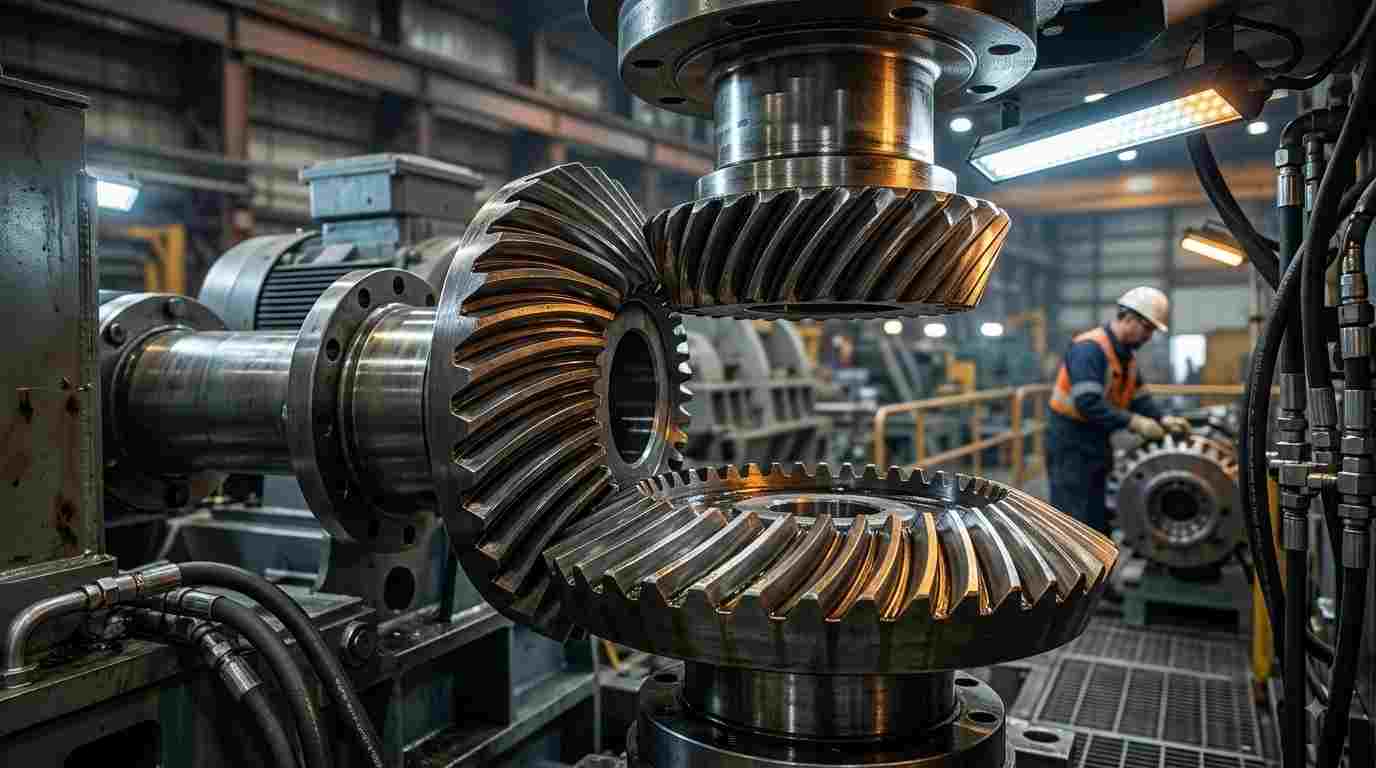
In complex machinery and mechanical drivetrains, power transmission often needs to redirect rotational motion across non-parallel, intersecting shafts. When drive shafts meet—most commonly at a 90-degree angle—bevel gears provide the foundational solution for smooth velocity transition and high torque capacity. Understanding the different types of bevel gears, pitch cone geometry, and heat treatment methods allows engineers to optimize performance in demanding industrial applications.
What Is a Bevel Gear and How Does Angular Power Transmission Work?
A bevel gear is a cone-shaped mechanical gear with teeth cut along a sloped surface. Unlike cylindrical spur or helical gears that operate on parallel axes, bevel gears are mounted on intersecting shafts to transfer rotational energy at an angle.
The foundational design of a bevel gear centers on its pitch cone. When two mating bevel gears mesh, their imaginary pitch cones meet at a single focal point along the shaft intersection. This geometric alignment allows seamless rotational motion transfer while enabling significant torque multiplication or speed reduction depending on the tooth ratio between the pinion and the gear.
Straight, Spiral, and Hypoid Bevel Gears: Key Differences
Selecting the correct bevel gear design depends on operational speed, noise limits, and torque demands:
-
Straight Bevel Gears: Feature straight teeth cut along the pitch cone toward the axis intersection. They engage across the entire face width simultaneously, making them cost-effective for low-speed, high-load machinery where operational noise is not a primary constraint.
-
Spiral Bevel Gears: Feature curved teeth cut at an angle along the cone surface. The teeth engage gradually, providing smooth, continuous overlap. This reduces tooth impact stress, operates quietly at high rotational speeds, and handles significantly higher torque loads than straight bevels.
-
Hypoid Gears: Similar to spiral bevels, but designed with non-intersecting offset shafts. The offset allows for larger pinion diameters and higher contact ratios, making them essential for heavy-duty automotive differentials and industrial gearboxes.
Critical Manufacturing Considerations: Pitch Cones and Tooth Contact Patterns
Manufacturing high-precision bevel gear sets requires exacting alignment standards to prevent premature tooth failure:
-
Shaft Angle & Pitch Cone Calculation: While 90-degree shaft angles are standard, custom bevel gears can be manufactured for acute or obtuse intersecting angles. Calculating the pitch cone angle ensures proper tooth mesh without binding or excessive backlash.
-
Tooth Contact Pattern Analysis: During assembly, technicians evaluate the contact pattern under load using dye or optical inspection. A centered contact patch prevents edge loading and stress concentration, ensuring even force distribution across the gear face width.
Heat Treatment and Surface Finishing for Extended Lifespan
Heavy equipment applications generate extreme surface contact pressures and sliding friction along bevel gear teeth. To maximize service life, steel bevel gears undergo specialized metallurgical treatments:
-
Carburizing and Quenching: Diffuses carbon into the outer layer of alloy steel gears (such as 8620 or 20MnCr5) to create a hardened, wear-resistant outer case while preserving a ductile, shock-absorbing core.
-
Lapping and Precision Grinding: After heat treatment, mating spiral bevel sets are lapped together with an abrasive compound (or CNC ground) to refine the tooth surface, minimize runout, and ensure near-silent operation.
For demanding automotive drivetrains, industrial machinery, and heavy equipment applications, partnering with a specialist for high-precision bevel gear manufacturing for angular power transmission ensures optimized gear geometry, maximum load handling, and long-term durability.

